‘They failed my son’: Sebastian Rogers’ dad sues sheriff, state agency over Tennessee teen’s disappearance
More than two years after Sebastian Rogers vanished from his Hendersonville home, his father says the agencies charged with protecting his son — and later finding him — failed at both.
What This Story Is About
- The father of missing Tennessee teenager Sebastian Rogers has filed two federal lawsuits against the Sumner County Sheriff’s Office and the Tennessee Department of Children’s Services, alleging both agencies failed his son — one before his February 2024 disappearance and one during the investigation that followed.
Why It Matters
- The lawsuits represent the first formal, public legal accounting of how government agencies handled both Sebastian’s welfare and his disappearance — and could force the release of investigative records, internal communications and sworn testimony that have never been made public.
What Happens Next
- Both lawsuits are now moving through federal court. If the cases proceed, attorneys could seek investigative reports, internal communications, child welfare records and sworn depositions from law enforcement and DCS officials.
For Context
- At the time of his disappearance, Sebastian Rogers was a 15-year-old with autism spectrum disorder, severe ADHD and a rare chromosomal condition who required daily support. His case became one of the most widely followed missing-child cases in the country, drawing national media coverage, true-crime podcasts and thousands of volunteers.
Catch Up
- Sebastian Roger’s mom described a “gaping hole” in her heart in an exclusive interview with WSMV4 nearly two years after her son’s disappearance.
- Stepdad Chris Proudfoot described feeling hopeless in a 2024 interview with WSMV4.
NASHVILLE, Tenn. (WSMV) - For 870 days, Seth Rogers has lived with a single unanswered question.
What happened to his son?
“I need my son home,” said Rogers. “There’s nothing else.”
Now, nearly two-and-a-half years after 15-year-old Sebastian Rogers disappeared without a trace from the Hendersonville home he shared with his mother and stepfather, his father is asking a second question he says has become just as important.
What happened to the investigation?
On Wednesday, Rogers filed two sweeping federal lawsuits that accuse the agencies responsible for protecting Sebastian before he disappeared, and investigating his disappearance afterward, of failing him at nearly every stage.
One lawsuit targets the Sumner County Sheriff’s Office (SCSO), alleging investigators mishandled the missing-person investigation from its earliest hours by failing to secure the home as a potential crime scene, pursue critical investigative leads and devote adequate resources to the case.
That suit also names Sumner County Sheriff Eric Craddock, and detective Brandon Carter, the alleged “sole detective assigned to Sebastian’s missing person investigation.”
The second lawsuit is against the Tennessee Department of Children’s Services (DCS), alleging the agency failed to protect Sebastian despite two closed investigations involving the teenager before he vanished.
Several DCS officials are also named in that complaint, including DCS Commissioner Margie Quinn, a case worker, an agency supervisor and a DCS team leader.
Together, the lawsuits paint the broadest and most detailed public picture yet of why Rogers believes the mystery surrounding his son’s disappearance is not simply about what happened on the night Sebastian vanished — but whether government agencies repeatedly missed opportunities both before and after that night.
“So, he was failed by both of them,” Rogers told WSMV4 Investigates during an exclusive interview.
“My son wasn’t protected. My son wasn’t found,” said Rogers. “It makes you want to sleep, but it’s a nightmare.”

A disappearance that still has no answers
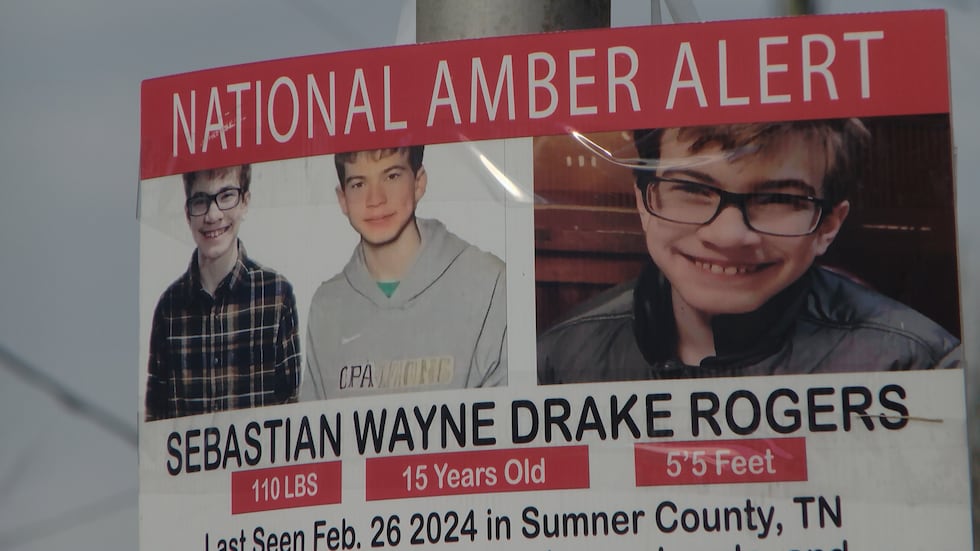
Sebastian Rogers disappeared sometime during the overnight hours of Feb. 25 or 26, 2024, from the Stafford Court home in Hendersonville where he lived with his mother, Katie Proudfoot, and stepfather, Christopher Proudfoot.
The disappearance immediately baffled investigators.
Sebastian was 15 years old and had been diagnosed with autism spectrum disorder, severe combined-type ADHD and 6Q27 Chromosome Deletion Syndrome — a rare genetic disorder associated with intellectual disabilities and developmental delays. According to court filings and his father, Sebastian required extensive support services, attended behavioral therapy multiple times each week, saw specialists at Vanderbilt University Medical Center and had never left home by himself.
When Sebastian went missing, his shoes remained inside the house. His cellphone was left behind. His Nintendo Switch remained on a table. The only item reported missing was a small flashlight.
According to a published account of the case by the FBI, Katie Proudfoot drove around the neighborhood and to Sebastian’s school searching for him before returning home. During that time, his Sebastian’s stepfather Christopher Proudfoot, who was reportedly three hours away in southwest Tennessee for work, called the local emergency communication center to report Sebastian missing.
Soon after his disappearance, Sebastian’s mother insisted that he had never run away before.
“I don’t know why he walked out that door,” Katie Proudfoot said during an interview with WSMV4 on March 4, 2024.
For Seth Rogers, however, the suggestion that Sebastian simply wandered away never made sense.
“No matter how I look at it, I just cannot wrap my head around my son walking out of that house,” Rogers said. “No matter where we lived, he’s never been one to just walk out of the house.”
A desperate search yields no clues
Within hours of Sebastian’s disappearance, authorities launched what officials described as one of the largest missing-child searches in Tennessee history.
An Endangered Child Alert issued the morning Sebastian disappeared was upgraded the following day to an AMBER Alert after investigators determined they had reason to believe the teenager had been abducted and was in imminent danger.
Hundreds of law enforcement officers joined the search.
Helicopters circled overhead.
Drones scanned wooded terrain.
Mounted patrols searched fields and creek beds.
Specialized K-9 teams tracked possible scent trails.
Thousands of volunteers poured into Sumner County.
Search teams eventually expanded into Kentucky, where investigators searched a landfill in White Plains after receiving information they believed warranted additional investigation.
Altogether, more than 2,000 volunteers searched roughly 44,000 acres.
Despite weeks of intensive search efforts, investigators found no confirmed evidence explaining what happened to Sebastian.
No arrests have been made.
No suspects have been publicly identified.
No one has been named a person of interest.
“How can you have seven different agencies and hundreds of people working on stuff and not find any speck of evidence that he was there?” asked Rogers.
For a time, the mystery became one of the country’s most closely followed missing-person cases.
National television networks covered the search and true-crime podcasts devoted hours to analyzing the case.
YouTube creators and social media investigators produced countless videos, theories and timelines attempting to explain Sebastian’s disappearance.
For Rogers, however, the attention never produced what he wanted most, Sebastian.
“It’s like God gave me a purpose in life. And he still is, I just got to find him,” Rogers said.
From confidence in the SCSO to doubt
Initially, Rogers believed investigators would solve the case.
But as days turned into weeks, he said he quickly began to doubt whether the SCSO was up to the task of finding Sebastian.
“I lost all faith,” said Rogers. “You’re supposed to have good faith in your law enforcement agency. And I have no faith in them at all.”
Within a month of his son’s disappearance, Rogers said the focus of his questions shifted from, “Where’s Sebastian?” to “What happened to the investigation?”
That question ultimately became the foundation of his first federal lawsuit.
According to the complaint filed on Wednesday, Rogers alleges the SCSO investigation was inadequate, negligent, and ultimately abandoned.
The 21-page civil rights suit claims investigators failed to secure the Proudfoot home, allowing family members and media inside, before it was processed as a crime scene.
It also alleges that investigators failed to verify Christopher Proudfoot’s alibi, and that they failed to investigate why surveillance cameras at the home were not working. According to the lawsuit, that “should have been a significant cause of suspicion and point of thorough investigation, because, upon information and belief, Katie Proudfoot installs and operates security cameras for a living.”
The complaint also alleges investigators did not adequately pursue a tip from a nurse at one of Sebastian’s doctor offices. According to the suit, the nurse reported that Katie Proudfoot cancelled Sebastian’s upcoming mental health appointment just three days before he disappeared. The lawsuit says the nurse described the cancellation as unusual, noting Sebastian was always present for his appointments. Investigators, the complaint alleges, never followed up on it."
The lawsuit also claims that SCSO stopped communicating with Rogers and there has been a “communications blackout” with him for the past 18 months.
“It says a lot when they won’t speak to me,” Rogers said. “To me, it says that they know that they screwed the pooch.”
“This looks to me like an amateur investigation,” said Darren Richie, the lawyer who represents Rogers and filed the lawsuit on his behalf.
“It doesn’t take an expert in investigations to know what’s supposed to happen when you have a missing 15-year-old autistic child,” he said. “This investigation, it was dead on arrival.”
WSMV4 Investigates contacted SCSO about the claims now included in Rogers’ lawsuit. The department has not responded to our request for an interview.
A second lawsuit: What DCS knew — a father who says he never got the chance
Unlike the Sheriff’s Office complaint, which argues investigators failed to pursue critical leads after Sebastian vanished, the DCS suit claims that agency failed to take protective steps that could have prevented Sebastian’s disappearance in the first place.
The complaint alleges the agency already possessed warning signs about Sebastian’s welfare, documented them in its own files, then closed two investigations without notifying his father.
For Rogers, that revelation has become one of the most painful parts of the case.
“What did I do for him not to tell me that he was scared?” Rogers asked. “I’m supposed to protect him. I failed him.”
Rogers said he had no idea DCS had investigated allegations involving Sebastian in 2022 and again in 2023 until after his son disappeared.
He said he learned the investigations existed only after hearing about them publicly and later obtaining DCS records through his attorney.
“Why wasn’t I informed? He could have come to live with me. I’d have taken him in a heartbeat,” said Rogers. “No parent should have to get an attorney to get records from a state agency to find out what was already recorded. That doesn’t make sense.”
According to the complaint, DCS first opened an investigation in September 2022 after Sebastian disclosed to a school professional that he had been sexually abused by another child while living in California.
During that investigation, the lawsuit alleges DCS documented concerns involving Sebastian’s home environment before closing the case in November 2022 without taking protective action.
Eight months later, DCS opened a second investigation after receiving allegations that Sebastian’s stepfather, Christopher Proudfoot, had struck him in the stomach.
The lawsuit claims Sebastian confirmed the incident to investigators, and that his stepfather allegedly admitted striking him. Despite that, the complaint says DCS closed the investigation three days later, determining no additional services were needed.
Approximately nine months later, Sebastian disappeared.
The complaint relies heavily on DCS’s own investigative records, arguing they show the agency had information suggesting Sebastian was a vulnerable child who required greater protection.
Among the allegations, the lawsuit claims DCS documented that Sebastian said he felt safest with his father. It also alleges the agency determined Sebastian qualified for the federal Title IV-E Candidacy Program, a designation for children considered at serious or imminent risk of removal from their homes.
The lawsuit argues those findings should have prompted additional protective action rather than the closure of both investigations.
“When you only have one side of the story, there’s no way to reach a reasonable conclusion,” Richie said. “Half the story leaves half the conclusion.”
Richie argues that had DCS involved Seth Rogers during its investigations, the outcome may have been different.
“I don’t think we’d be here today talking,” he said. “I think Seth would’ve corroborated what Sebastian was feeling, and I think this would’ve taken a very different turn.”
The lawsuit also alleges DCS violated Seth Rogers’ constitutional rights by failing to notify him of either investigation, despite documenting that Sebastian identified him as the parent with whom he felt safest.
“There’s no words for it, they failed my son. They didn’t try to protect him,” Rogers said.
WSMV4 Investigates reached out to DCS about the lawsuit. In an email statement the agency wrote: “As a matter of practice, the Department generally does not comment on pending litigation. Additionally, DCS is unable to comment on specific cases due to state and federal confidentiality laws. Our priority remains, and will always remain, the safety and well-being of children in Tennessee.”
What happens next?
Both lawsuits are now moving into federal court, where Rogers and his attorney hope the discovery process will force government agencies to publicly answer questions that they say have gone unanswered for nearly two-and-a-half years.
If the cases proceed, attorneys could seek investigative reports, internal communications, emails, child welfare records, training materials and sworn testimony from deputies, detectives, DCS employees and other officials involved in Sebastian’s case.
Those records could provide the first detailed public look at decisions made before Sebastian disappeared and during the investigation that followed.
Whether the lawsuits ultimately succeed, however, will be decided in court, because for now, the allegations contained in both complaints remain just that, allegations.
As detailed as the case filings are, neither lawsuit identifies who caused Sebastian’s disappearance.
And neither suit alleges that Katie or Christoper Proudfoot is legally responsible for Sebastian’s disappearance.
Instead, both lawsuits argue government agencies failed to meet their responsibilities after receiving information they should have acted upon.
“I know they didn’t do their job. You know how I know? We don’t have Sebastian here sitting with us today,” Richie said.
Katie and Christopher Proudfoot declined WSMV4’s request for an on-camera interview to discuss Rogers’ claims.
However, neither has been arrested in connection with Sebastian’s disappearance.
And neither has been named as a suspect nor publicly identified by law enforcement as a person of interest.
Both have consistently denied any involvement in Sebastian’s disappearance.
In previous interviews with WSMV4, Katie Proudfoot described the accusations directed at her family as deeply painful.
“It hurts,” she said. “It hurts a lot.”
A father still searching
In both federal cases, Rogers’ attorney is seeking millions of dollars, plus injunctions to force each agency to change their policies and refocus the investigation into Sebastian’s disappearance.
Specifically, the lawsuit against SCSO demands $10 million plus punitive damages, and the suit against DCS seeks $15 million plus punitive damages.
While Richie said neither case is about money, he wants the dollar amount to send a clear message.
“It is a statement of alarm,” Richie said. “It is to bring attention to the matter.”
Rogers says the suits are about forcing accountability.
He also prays renewed focus on the case will bring about an answer to the only question in his mind that matters.
Where is Sebastian?
“He’s alive. He’s just lost,” Rogers said.
That belief is what keeps him searching, and why he said he has driven more than 100,000 miles in his truck across multiple states chasing leads.
And it is why, more than two years later, he says he refuses to stop asking questions.
Only now, those questions may ultimately be asked and possibly answered in federal court.
“I want to hug my son in the morning,” Rogers said. “I want to feel his presence. I don’t want to wake up from these nightmares anymore.”
Copyright 2026 WSMV. All rights reserved.